


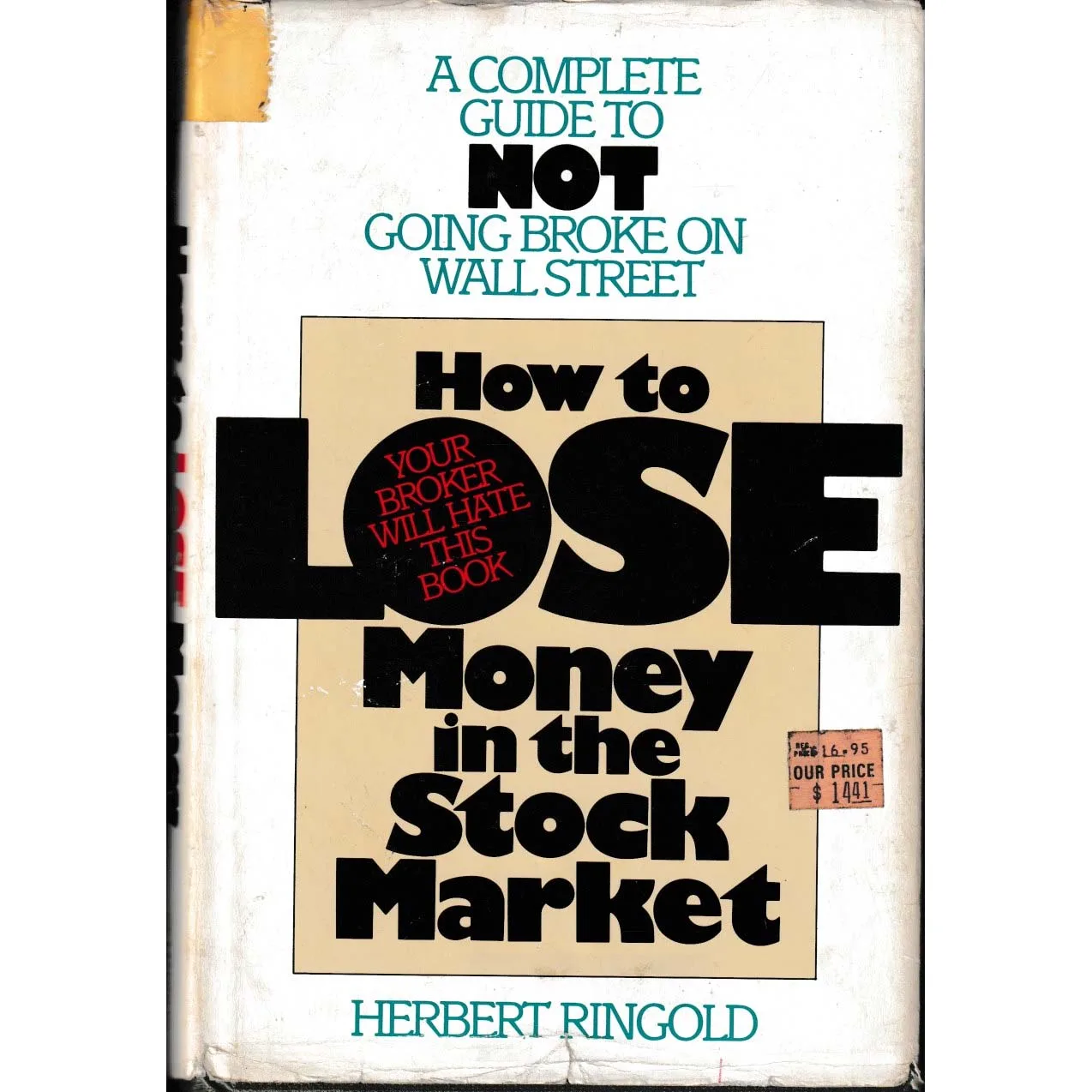
How To Lose Money In The Stock Market - A Complete Guide To Not Going Broke On Wall Street
Publisher: St Martins Press
Format: Hardback
ISBN: 0312396341
How to Lose Money in the Stock Market – A Complete Guide to Not Going Broke on Wall Street (1986) – Herbert Ringold
St. Martin’s Press • ISBN: 0312396341 • Condition: Good
Financially alarming, physically reassuring, from Crappy Old Books
Wall Street has never lacked books promising to make you rich.
This is not one of them.
How to Lose Money in the Stock Market is the rare, honest investment book that says the quiet part out loud:
“You are absolutely capable of wrecking your finances. Here’s how it usually happens.”
Published in 1986, smack in the era of big hair, big shoulder pads and bigger delusions about eternal bull markets, Herbert Ringold calmly walks you through the many, many ways investors separate themselves from their cash – and how, with effort, you might avoid being one of them.
It’s like a self-help book written by your future, slightly broke self, waving frantically from the other side.
Condition: Good (unlike most portfolios after a “hot tip”)
When Crappy Old Books says Good, we mean:
-
The cover is intact and respectably sharp, not peeling like a junk bond in ‘87.
-
The spine is solid with maybe a gentle crease or two – the physical echo of past readers thinking, “Wow, I’ve done all of these mistakes.”
-
All pages are present and firmly attached – no missing section that secretly explains the one actual way to get rich, no ripped-out “don’t do this” chapter.
-
Light, honest wear: slightly softened corners, mild age-toning, perhaps the faint aura of having spent time on the bedside table of someone who has learned things the hard way.
No coffee tsunamis across the “risk management” chapter, no margin notes shouting BUY in red biro, no evidence of having been hurled against a wall after a bad trading day. Just a tidy Good condition reminder that the market does, in fact, bite.
What’s inside (besides bruised optimism)?
Ringold goes through the greatest hits of financial self-sabotage, including but not limited to:
-
Buying on tips, hunches, and vibes instead of research
-
Confusing a bull market with your own genius
-
Refusing to sell losers because “they’ll come back, they have to”
-
Overtrading, overleveraging, and generally overestimating your emotional stability
-
Ignoring diversification because “this one can’t miss” (it can, it will)
-
Falling deeply in love with a stock, like it’s going to write you Valentine’s cards and pay your mortgage
It’s a tour of:
-
Fear, greed, denial, regret
-
The psychology of investing badly
-
And all the ways perfectly smart people behave like complete lunatics as soon as there’s a ticker symbol involved
All delivered with dry humour and the clear subtext:
“You’re not special. The market has seen your type before.”
1986 Wall Street flavour… with suspicious relevance
Yes, this is very much a mid-80s book:
-
References to brokers you call on the phone like it’s a normal human activity
-
Charts drawn with actual lines rather than “your screen looked like this” screenshots
-
The faint shadow of the coming 1987 crash, which this book reads like an accidental prequel to
But the jokes and warnings land perfectly in the age of:
-
Day-trading apps
-
Meme stocks
-
Crypto spirals
-
And people taking financial advice from strangers with cartoon avatars
Because the tech changed.
The behaviour? Not so much.
Why this is perversely useful
As investment books go, this one is:
-
Weirdly practical: it shows you what failure looks like so you can stop auditioning for the role
-
Comforting: you realise you’re not uniquely foolish, merely part of a proud, global tradition
-
Surprisingly timeless: “don’t risk money you can’t afford to lose” hasn’t exactly expired as a concept
You can treat it as:
-
A field guide to your own worst impulses
-
A museum of Other People’s Mistakes (sure, keep telling yourself that)
-
Pre-emptive therapy for anyone who has ever thought, “It can only go up from here.”
Why a Good used copy is perfect
Brand new, this would feel like a warning.
Second-hand, it feels like proof.
From Crappy Old Books, this Good copy:
-
Has almost certainly passed through at least one pair of hands that did not entirely heed its message
-
Comes lightly worn but fully intact, like a veteran who has seen enough bull and bear markets to stop being impressed
-
Is cheap enough that simply buying the book will not in itself constitute a major financial error
This is the financially safest decision you’ll make all week.
Ideal for readers who:
-
Have recently discovered the stock market and are currently in the “I alone can beat this” phase
-
Have already been humbled by a market correction and are ready for some uncomfortable honesty
-
Enjoy wry financial writing that admits humans are chaos wrapped in overconfidence
-
Want a gift for that one friend who keeps saying “this time it’s different” about every bubble
Also highly suitable for:
-
Economists with a sense of humour
-
Recovering day-traders
-
Anyone who has ever looked at a chart and thought “I’m sure it’ll bounce”
The bare financials
-
Title: How to Lose Money in the Stock Market – A Complete Guide to Not Going Broke on Wall Street
-
Author: Herbert Ringold
-
Publisher: St. Martin’s Press (1986)
-
ISBN: 0312396341
-
Condition: Good – gently used, structurally sound, psychologically necessary
How to Lose Money in the Stock Market: for when you’re finally ready to admit that your worst enemy on Wall Street is not “the system,” “the Fed,” or “the algos” – it’s you, with a brokerage account and feelings. Supplied in honestly Good condition by Crappy Old Books, devoted curators of wisdom acquired the expensive way.
Keep browsing: See more Non-Fiction books Other books by Herbert Ringold
